Precision Bias-ply Formatting in Aerospace Manufacturing
Why this automated method is a scalable approach for high-rate thermoplastic production

Thermoplastic composites continue to attract attention across the aerospace industry.Their potential benefits are well understood: shorter processing cycles, weldablestructures and manufacturing approaches that are well suited to higher production rates.
As manufacturers look to scale these materials from niche applications to larger structural components, however, one practical challenge has remained difficult to solve.
The Right Material
Many aerospace laminates rely on a combination of 0°, 90°, +45°, and -45° plies to achieve the required structural performance. While thermoplastic unidirectional tape is widely available, creating efficient off-axis material formats traditionally involved tradeoffs.
One option is woven fabric. Woven thermoplastic fabrics provide an established and convenient method for incorporating multiple fiber orientations within a single material.They are familiar to manufacturers and can be supplied in formats well suited to a variety of molding processes.
The drawback is that weaving introduces crimp. Fibers are no longer perfectly straight, reducing their ability to carry load as efficiently as unidirectional reinforcements. For high-performance aerospace applications, engineers have long preferred the mechanical advantages that come from keeping fibers as straight as possible andplacing them only where they are needed.
The alternative has been to build laminates from unidirectional tape. This preserves the performance benefits of straight-fiber architectures, but introduces a different challenge. Off-axis plies typically must be created through additional fabrication steps before they can enter the manufacturing process. Depending on the application, that can require material handling, welding, staging and preparation activities that add labor, consume factory space and complicate production planning.
For years, this has been one of the practical realities of working with thermoplastic unidirectional tape. Manufacturers could achieve the performance advantages they wanted, but often through processes that were difficult to scale as production volumes increased.
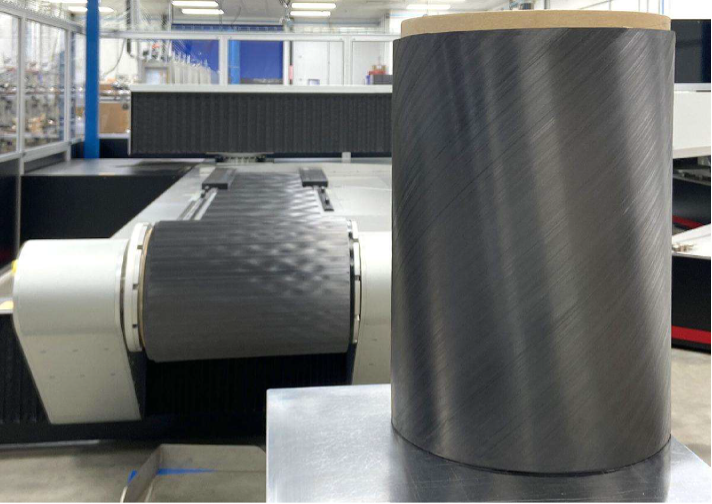
Automated bias-ply production allows for the conversion of unidirectional tape into precisely controlled formats at the point of manufacture, ready for use in manufacturing operations.
Higher Throughput, More Supply Chain Advantages
Recent advances in automated bias-ply production are beginning to change that equation.
Instead of creating off-axis material at the point of manufacture, unidirectional tape can now be converted into precisely controlled +45°, -45°, and 90° formats throughautomated formatting processes. The resulting material arrives ready for use inmanufacturing operations, combining the advantages of a straight-fiber architecture witha format that is considerably easier to deploy in production.
From a manufacturing perspective, the impact is straightforward. Material preparationbecomes more predictable. Factory workflows become simpler. Operators spend less timecreating feedstock and more time producing parts. Material arrives organized, identified and ready for processing.
The benefits become even more pronounced as production rates increase.
The aerospace sector continues to pursue greater automation and higher throughput.Much of the industry’s focus naturally falls on molding equipment, placement systemsand production cells. Yet capacity is ultimately determined by the speed of the entiremanufacturing chain. Any process that requires substantial manual preparation canbecome a constraint as volumes grow.
Automated bias-ply production helps remove that constraint. Rather than fabricating off-axis material one roll at a time on the factory floor, manufacturers can receive pre-engineered material formats prepared through a highly repeatable industrial process. The result is a manufacturing flow that is easier to scale and better aligned with theproduction rates future aerospace programs will demand.
There are supply chain advantages as well. Longer material runs, more consistent splices, custom widths and less handling can all contribute to improved efficiency and better yields. Those gains may seem incremental when viewed individually, but together they can have a meaningful impact on the economics of production.
In one aerospace application, transitioning to automated bias-ply formats reduced labor associated with material preparation by approximately 45% to 60% andimproved yields over 20%. Importantly, it demonstrated that a longstanding tradeoff may no longer be necessary.
For years, manufacturers often had to choose between the processing convenience ofwoven materials and the performance advantages of straight-fiber unidirectionalarchitectures. Automated bias-ply technology offers a path to achieving both.
As thermoplastic composites continue their expansion into demanding aerospaceapplications, that may prove to be one of the more important developments in theindustry’s ongoing effort to combine performance, manufacturability and production scale